This guide explains the test and tag cost per item, what that price covers, and how to compare quotes so you can budget with confidence and stay compliant with AS/NZS 3760:2022.
Key takeaways
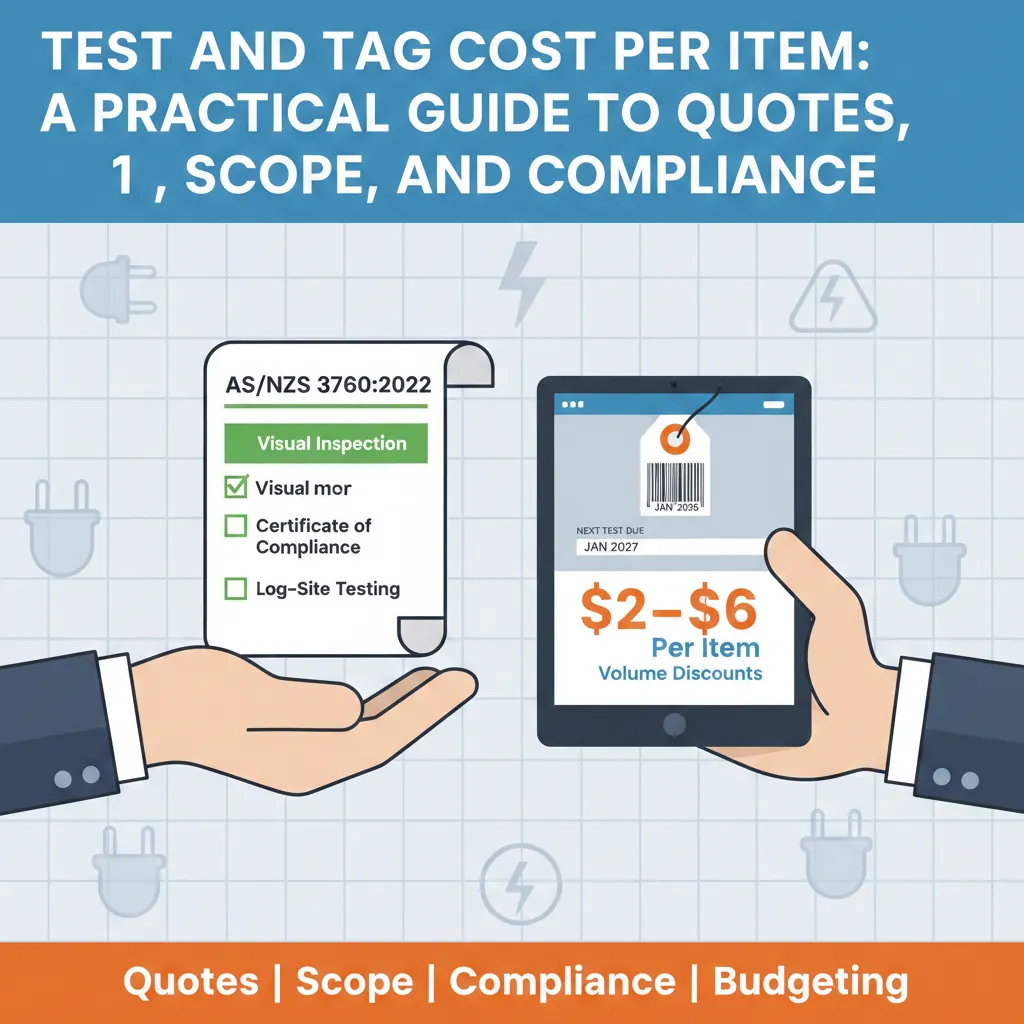
- Typical per-item pricing runs $2–$6 excluding GST, with volume discounts as item counts rise
- Total cost = (Number of Items × Cost Per Item) + Travel/Call-Out Fee + GST
- A certificate of compliance is usually valid for 12 months and should be used to schedule re-tests
- On-site testing suits sites where downtime is costly or access is limited
- Comparing quotes on scope, SLA, and documentation matters as much as comparing price
Introduction
Welcome to a practical guide on the costs behind test and tag work. If you're a site or business manager, understanding the financial side of safety checks helps you plan better. In particular, this guide focuses on the test and tag cost per item and how it translates into real budgeting decisions. You'll see how to compare quotes, understand what's included, and get a clear sense of timelines, certificates, and templates.
In this introduction, the key idea is that the test and tag cost per item is more than a price tag. It impacts how you schedule work, how you handle records, and how you stay compliant with safety standards (AS/NZS 3760:2022). You'll learn about when on-site testing makes the most sense, what a certificate of compliance includes, and how to use a log book template to manage re-tests. By the end, you'll be ready to request quotes with a solid checklist and a simple calculator to estimate total spend. For broader context on key steps like visual inspection, see The Unseen Danger: Why Visual Inspection is the Most Critical Step in Test and Tag.
Sections ahead map out the value and choices, with plain language, clear steps, and practical examples. You'll also see how to benchmark pricing using industry ranges and what to expect from standard services like on-site testing, certificate delivery, and after-hours options.
References:
– Appliance tester buying guide
What is Involved in the Test and Tag Cost Per Item
Test and tag cost per item is the per-unit charge used by many providers when testing and tagging electrical appliances and equipment. The price is designed to reflect the basic work needed to verify safety and mark next due dates. This section defines what that per-item price covers and how it fits into total spend.
What the Per-Item Cost Covers
When you see a per-item rate, the service typically includes:
- Visual inspection for damage or wear
- Electrical testing with calibrated equipment
- Attaching a test tag that shows results and next due date
- Basic on-site reporting and a simple compliance note
- Handover documentation to your team
For context on practical scope, see Test and Tag Office Equipment for Workplace Safety.
Pricing ranges and volume discounts
- Typical range: $2–$6 per item, excluding GST
- In some regions and for complex items, rates can go higher
- Volume discounts are common as item counts rise
Common cost drivers to be aware of
- Item type and accessibility: hard-to-reach gear, fixed machinery, 3‑phase equipment
- Quantity of items: larger jobs yield lower unit costs
- Travel and call-out fees: location-based fees commonly seen
- GST/VAT: most quotes exclude tax; include GST in your final budget
- Retest intervals and frequency: re-testing cadence can affect spend
- Data entry and reporting format: digital reports may carry extra charges
A simple cost calculation formula
Total Cost = (Number of Items × Cost Per Item) + Travel/Call-Out Fee + GST
Example: 75 items at $3.50 per item, with a $160 call-out fee. Excluding GST: 75 × 3.50 = 262.50; add 160 = 422.50. If GST is 10%, total becomes 464.75.
On-site Test and Tag Services
On-site testing and tagging is a delivery model where the technician visits your location to test, tag, and hand over results. It is often preferred where downtime is costly or access is limited.
What on-site services typically include
- A scheduled, on-site visit by a qualified technician
- Testing and tagging conducted at your location
- Basic compliance notes and a handover of results
- Optional photographs of tagged equipment for your records
Benefits of on-site service
- Convenience: tests fit around your schedule and site layout
- Reduced downtime: equipment remains usable and tagging is immediate
- Location-specific compliance: tags reflect your site conditions
- Real-time problem identification: failures can be spotted and documented on the spot
Ideal scenarios
- Manufacturing and production facilities where downtime is costly
- Construction sites with portable or mixed inventories
- Hospitals and critical services where immediate safety assurance matters
- Multi-location businesses needing centralized testing
Exclusions often seen in on-site pricing
- Extended or custom reports (e.g., detailed failure analysis)
- Specialized certificates beyond standard documentation
- Bulk data export to asset management systems
- Follow-up retests for items that fail (charged separately)
- After-hours or weekend scheduling (premium rates)
Test and Tag Certificate of Compliance
A test and tag certificate of compliance is the formal document showing that equipment has been tested and meets safety standards. It is essential for audits, safety checks, and liability protection.
Why the certificate matters
- Regulators and insurers require documented proof of testing
- It helps demonstrate proactive safety management
- It supports audits and compliance reviews
What the certificate typically contains
- Equipment list (type, model, serial, location)
- Test results (pass/fail)
- Test dates and next due date
- Authorized technician details
- Test standard reference (AS/NZS 3760:2022)
- A compliance statement
Validity and scheduling
- Certificates are typically valid for 12 months
- Use the next-due date to schedule re-tests
Delivery format and storage
- Digital copies (PDF) and/or hard copies
- Storage options: provider cloud or your premises
- Accessibility for audits and insurance checks
Cited references for certificate content and validity:
– Related guidance on certificate content and validity can be inferred from price-list sources also listed here.
How long does a test and tag service take (timelines and timing context)
Understanding how long a test and tag service takes helps you schedule with less disruption. Timing is influenced by item types, site layout, and data capture methods.
- Number and type of items: more items, more time
- Accessibility and site layout: items spread over multiple areas add time
- Safety procedures and environment: lockout/tag-out steps can slow things
- Data capture and reporting: on-site data entry adds time vs post-processing
| Site size | Typical duration |
|---|---|
| Small site (20–50 items) | 1–2 hours |
| Medium site (50–150 items) | 3–6 hours (often a one-day job) |
| Large site (150–500 items) | Full day or multi-day; may use 2+ technicians |
| Very large site (500+ items) | Multi-day or phased scheduling |
Notes: These timings assume standard equipment. Highly specialised items may add time. Data capture on-site vs off-site can shift duration.
After Hours Test and Tag Service
After-hours testing is scheduling work outside standard business hours—such as evenings, weekends, or public holidays—to reduce downtime and fit shift schedules.
- Evening rates (after 5 PM weekdays): often a 10–25% surcharge
- Weekend and holiday rates: 30–50% surcharge
- Higher minimum call-out fees for after-hours
- Expedited response or scheduling may incur extra charges
Negotiating after-hours arrangements
- Lead time: 2+ weeks for competitive rates
- Response SLAs: define arrival windows
- Guaranteed retest windows: ensure a return if needed
- Bundled rates: larger jobs or ongoing work can unlock discounts
Test and Tag Log Book Template
A log book is a structured record that tracks equipment status, test dates, and next-due dates. It complements the certificate of compliance and supports ongoing compliance.
- Equipment ID / Serial Number
- Equipment Type and Description
- Location
- Last Test Date
- Next Due Date
- Test Result (Pass/Fail)
- Technician Name
- Certificate Reference
- Notes
Accessing templates: Providers often supply a log book template; request a sample during the quote stage. The post mentions a downloadable Excel/CSV option for practical use.
Reference guidance:
expectations, are captured in the price-list sources listed earlier
– Appliance-tester buying guide and related resources provide a broader context for template usage: Appliance tester buying guide
How to Compare Quotes and Choose a Provider
A structured approach helps you move beyond price alone and choose a provider who offers complete scope, reliable service, and strong documentation.
- Scope and inclusions: on-site vs off-site; reporting; retests
- Pricing structure: per-item cost; travel fees; minimum charges; after-hours
- SLA and turnaround: time to complete; certificate delivery windows
- Certificate delivery method: digital vs hard copy
- Data handling and records: log book support and data export
- Warranty and support: retest windows, dispute handling
A practical rubric can help you compare apples to apples:
– Cost per item (lower is better)
– Total job cost (all-in, inc. GST)
– Turnaround time to certificate
– Includes log book template
– After-hours availability
– Overall score
Practical Examples and Scenarios
Scenario 1: Small Professional Office (60 Items)
Environment: A small office with computers, printers, kettles, and charging cables.
- 60 items at $3.80 per item
- $160 call-out fee
- Subtotal: 60 × 3.80 = 228; total before GST = 388
- GST (10%): 38.80
- Total: 426.80
Timeline: 2–3 hours. Service fit: On-site testing is ideal; quick certificate delivery; log book template helps annual re-tests. For an office environment, see Test and Tag Office Equipment for Workplace Safety.
Scenario 2: Manufacturing Floor (280 Items)
Environment: Fabrication shop with handheld tools, power equipment, fixed machinery
- 280 items at $4.60 per item (volume tier)
- $160 call-out
- Extra: 20 items requiring additional RCD testing at $2.00 extra each
- Subtotal: 280×4.60 = 1,288; add 160 + 40 = 1,488 (ex. GST)
- GST: 148.80
- Total: 1,636.80
Timeline: 6–8 hours; may require two technicians or phased visits. Service fit: On-site with multiple technicians; detailed reporting; log book is essential for high-volume re-tests. For NZ context on cost structures, see The Indispensable Role of Test and Tag in NZ.
Scenario 3: Construction Site (150 Items, Temporary)
Environment: Short-term project with portable tools and temporary infrastructure
- 150 items at $4.60 per item
- Site complexity surcharge: +100
- After-hours premium: +138 (20%)
- Subtotal: 150×4.60 + 100 + 138 = 1,008
- GST: 100.80
- Total: 1,108.80
Timeline: 4–5 hours. Service fit: On-site testing with after-hours scheduling; certificate turnaround crucial for site sign-off; log book supports daily checks. For NZ context on cost structure, see The Indispensable Role of Test and Tag in NZ.
FAQs and Common Concerns
- Is re-testing included in the initial quote? Usually not; re-tests are typically charged as a separate service, or bundled if you have a service agreement.
- What happens if equipment fails testing? It is tagged Do Not Use; some providers offer re-testing after repairs within a set window.
- How long is the certificate valid? Generally 12 months; plan the next re-test to avoid gaps.
- Long-term contracts: necessary? Not always; many jobs are one-off, but annual service agreements can reduce overall cost.
- Can testing happen without disrupting operations? Yes; phasing the work by department or area can minimize downtime.
NZ-specific guidance on on-site scope and after-hours considerations: Test and Tag in Hospitals: The Hidden Lifesaver and The Unseen Danger.
References used throughout the post and for in-section context
– Appliance tester buying guide
Downloadable assets (log book template)
– Log book template (Excel/CSV) — request during quote stage or obtain from providers as part of onboarding.
– Downloadable template preview and example entries are intended to help map fields to your own asset management system.
Note
A practical, itemized quote is the best path to clarity. Use the simple cost calculator in the sections above and the quote comparison rubric to benchmark offers. The ultimate goal is a transparent, compliant, and cost-effective approach to electrical safety testing that keeps your operations safe and business-ready.
Previous Blog Posts
- Test and Tag Office Equipment for Workplace Safety
- How to Create a WordPress Website: Beginner's Guide
- Test and Tag in Hospitals: The Hidden Lifesaver
- The Unseen Danger: Why Visual Inspection is the Most Critical Step in Test and Tag
- The Crucial Importance Test and Tag
- The Indispensable Role of Test and Tag in NZ