A practical guide to choosing an accredited, licensed test and tag provider, covering decision criteria, technician qualifications, questions to ask, a provider checklist, and how to find local, verified services.
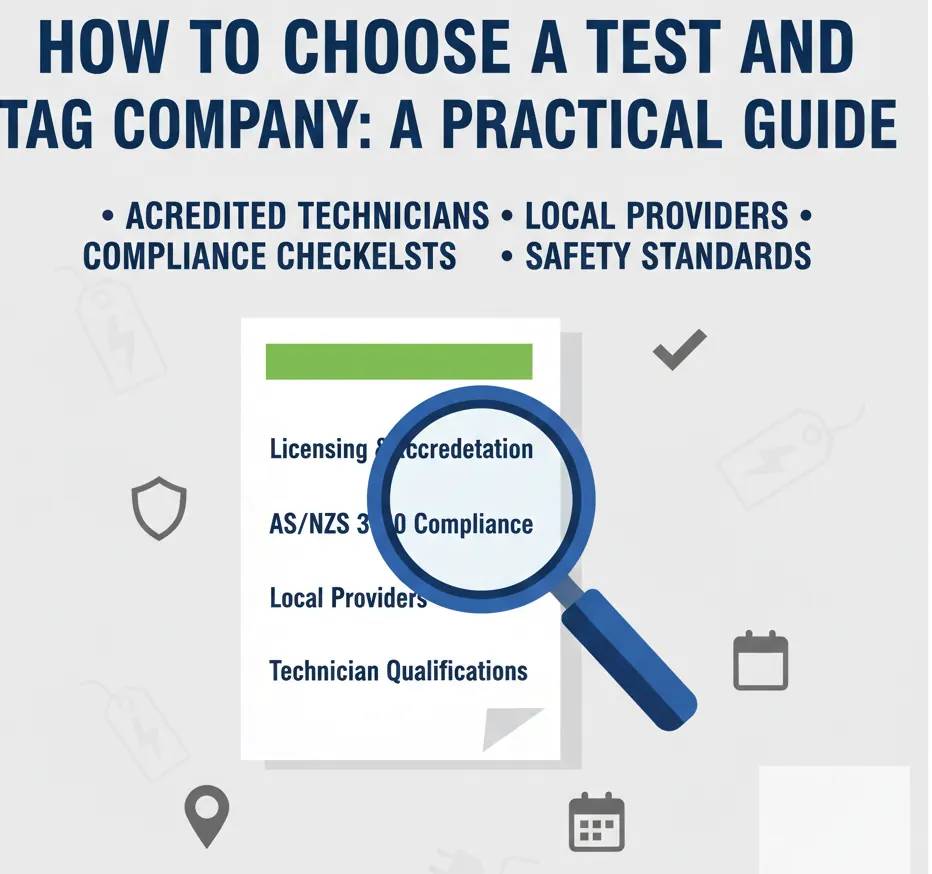
Key takeaways
- Safety and compliance come first: always verify licensing, accreditation, and competency. Who can test and tag matters.
- Look for accredited standards such as AS/NZS 3760 alignment.
- Expect thorough reporting, retest scheduling, and clear remediation options to support audits. What is test and tag?
- Use a simple RFP-style checklist and a side-by-side scoring framework to compare quotes. Decision aids.
- Proximity matters: local providers enable faster fault response, easier on-site visits, and better alignment with local rules.
Estimated reading time: 9 minutes
Table of contents
- 1. How to Choose a Test and Tag Company
- 1.1 Decision criteria
- 1.2 Step-by-step decision process
- 2. Qualified Test and Tag Technician
- 3. What to Ask a Test and Tag Service
- 4. Test and Tag Provider Checklist
- 5. Accredited Test and Tag Services Near Me
- 6. Are Test and Tag Technicians Licensed?
- 7. Additional Decision Aids
- 8. Evidence, Credibility, and Case Examples
- 9. Practical Deliverables to Include in the Post
- 10. Call to Action and Next Steps
- 11. SEO & Maintenance Notes
- FAQ
1. How to Choose a Test and Tag Company
This section lays out the decision criteria and a simple, repeatable process to select a partner you can trust. The right provider protects people, equipment, and your operations.
1.1 Decision criteria
- Licensing & legal eligibility – Many places require testing by a licensed electrician or a competent person who understands the relevant electrical safety standard. Providers should show evidence of appropriate training and business licences. Source.
- Accreditation & standards compliance – Look for alignment with national safety standards such as AS/NZS 3760 and any sector-specific rules; seek third-party accreditation or recognised industry schemes. NZ context.
- Technical competency & scope – The provider should test single-phase and three-phase equipment, RCDs, and leakage where required. Consider environments like offices, factories, or labs. Tech scope.
- Coverage & capacity – Ensure serviceability across all locations, including after-hours or staged visits. Coverage considerations.
- Reporting, documentation & data management – Written test reports, asset lists, retest scheduling, and digital records support audits. What is test and tag?
- Insurance & risk management – Require public liability and, where applicable, workers' compensation; ask for certificates of currency. Insurance guidance.
- Price vs value – Look beyond headline price: consider reporting quality, responsiveness, and reliability for risk management. Value matters.
1.2 Step-by-step decision process
- List your needs – Identify items, locations, and risk level for offices, factories, or labs. Guidance.
- Shortlist 3–5 providers – Use searches like "accredited test and tag services near me." NZ guide.
- Pre-screen for compliance – Review licensing, accreditation, insurance, and standards mentions in provider materials. Baseline article.
- Use the question list – Run a consistent brief with all providers to standardize replies. Office guide.
- Score providers – Apply a simple 1–5 framework on key criteria to compare value. Scoring framework.
- Check references – Ask for at least one reference from a similar environment. Reference checks.
- Run a small initial engagement – If possible, test on one site or department first. Pilot guidance.
2. Qualified Test and Tag Technician
Purpose: Define what makes a "qualified test and tag technician" with concrete criteria.
2.1 Core qualifications
- Recognised test and tag training or an electrical trade qualification. The person should be a competent person under the standard. Competence criteria.
2.2 Technical skills
- Proficient with portable appliance testers (PATs) and capable of visual inspections, insulation resistance, earth continuity, polarity, leakage, and RCD testing where required. Tech scope.
2.3 Environment experience
- Experience in offices, factories/warehouses, and labs; different contexts affect risk and testing intervals. Environment guidance.
2.4 Ongoing training and updates
- Refresher training and updates to standards (AS/NZS 3760) and new test methods. Training resources.
2.5 Professional attributes
- Meticulous tagging with date and technician ID, and clear explanations of failures and corrective actions. Tagging standards.
3. What to Ask a Test and Tag Service
A practical, reusable question list you can drop into RFPs or briefs. Each item anchors to best-practice references.
3.1 Licensing & qualifications
- "Are your test and tag technicians licensed or certified, and under which scheme/standard?" Licensing details.
- "Can you provide licence or competency certificate numbers?" Competency verification.
3.2 Accreditation & standards
- "Which safety standards do you work to (e.g., AS/NZS 3760)?"
- "Are you accredited or audited by a recognised industry body?" Accreditation checks.
3.3 Insurance & safety
- "Do you carry current public liability and workers' compensation insurance? Can you share certificates?" Insurance evidence.
- "Do you provide Safe Work Method Statements or similar risk assessments for each visit?"
3.4 Equipment & test scope
- "What test equipment do you use, and how often is it calibrated?"
- "Can you test three-phase equipment, RCDs, and perform leakage testing where required?"
3.5 Reporting & documentation
- "Will we receive full test reports with readings, pass/fail status, and asset lists?" Reporting basics.
- "How do you help us track retest dates and maintain compliance records?" Reminders & records.
3.6 Remediation & follow-up
- "What happens if an item fails—do you remove it from service, tag it unsafe, and advise on repair/replacement?"
- "Do you offer minor repairs or coordinate with electricians for rectification?"
3.7 Service levels (SLA) & scheduling
- "What are your typical response times for bookings and urgent visits?"
- "Do you offer after-hours or weekend work to minimise disruption?"
3.8 Warranties & guarantees
- "Do you provide any guarantees on your work or support in case of audit or incident investigations?"
4. Test and Tag Provider Checklist
Purpose: A printable at-a-glance checklist you can use before engaging a provider.
4.1 Checklist layout
Simple list with check boxes covering licensing, accreditation, insurance, technical scope, reporting, SLA, pricing, and additional notes.
4.2 Checklist items
- Licensing, competency evidence
- Accreditation/standards
- Insurance (public liability, workers' comp)
- Technical scope (equipment types supported; instrument calibration)
- Reporting & records (readings, asset lists, retest reminders)
- SLA and on-site flexibility
- Price and contract clarity
- Additional notes: PDF download option and how to fill in
4.3 PDF download option
Indicate that a downloadable PDF version is available for offline use. Office reference.
5. Accredited Test and Tag Services Near Me
Purpose: Help readers locate legitimate local providers and understand why proximity matters.
5.1 Local proximity rationale
- Faster response times for faults and retesting; easier on-site visits; better alignment with local regulations. Proximity benefits.
5.2 How to locate local providers
- Use phrases such as "accredited test and tag services near me" and "test and tag [city] [standard]."
5.3 Validation steps for accreditation
- Ask which body accredited them and confirm via that body's register. Cross-check name, licence number, and current accreditation. Accreditation checks.
5.4 Local SEO note
Update local provider references annually to reflect market changes. Keep it current.
6. Are Test and Tag Technicians Licensed?
This section answers licensing realities and verification steps.
6.1 Typical licensing landscape
- In many regions, testing must be performed by a licensed electrician or a competent person; AS/NZS 3760 is a baseline reference. Standard source.
6.2 Verification steps
- Request licence/competency numbers, training course names, and regulator searches. Cross-check against registers. Verification guide.
6.3 Red flags for unlicensed providers
- Vague answers, missing documentation, or no standards/insurance. Red flags.
7. Additional Decision Aids
Extra procurement aids beyond core sections.
7.1 Side-by-side quote comparison framework
Table with providers as columns and cost, coverage, SLA, accreditation, licensing, and reporting as rows. Score items 1–5 to pick best value. Office comparison.
7.2 Service Level Agreements (SLAs)
Consider response times, report turnaround, and after-hours support. SLA considerations.
7.3 Data retention and documentation formats
Confirm retention periods and formats (PDF/Excel/portal) and compatibility with your systems. Documentation options.
8. Evidence, Credibility, and Case Examples
Use standards references and practical examples to build trust.
8.1 Standards and authorities to cite
AS/NZS 3760 and local safety authorities guide testing practices and licensing expectations. Cite sources like WorkSafe Queensland and Gotestandtag.
8.2 Short case studies
Office: strong reporting and reminders helped pass an audit with no non-conformances. Factory: three-phase and RCD testing avoided downtime. Laboratory: careful scheduling supported accreditation renewals. Case notes.
8.3 Anonymised quotes
Short quotes about audits and reliability illustrate value. Credibility.
9. Practical Deliverables to Include in the Post
Deliverables you can reference or offer include printable checklists, RFP briefs, and a side-by-side scoring framework. Deliverables hub.
10. Call to Action and Next Steps
Immediate actions: download the checklist, shortlist 3–5 local providers, send the prepared questions, and compare responses. Optional soft CTA: invite readers to view your own safety/compliance pages. Next steps.
11. SEO & Maintenance Notes
Six core keywords should appear across headings, intro, body, and conclusion: how to choose a test and tag company, qualified test and tag technician, what to ask a test and tag service, test and tag provider checklist, accredited test and tag services near me, and are test and tag technicians licensed. Include related terms like PAT, RCD testing, competency, and certification as natural variations. Link to relevant safety content and product/service pages where appropriate. Internal linking plan.
Frequently Asked Questions
- Q1. Are test and tag technicians licensed where I am?
- Q2. What should I look for in a retest report?
- Q3. How do I verify a provider's accreditation?
- Q4. How quickly can a local provider respond to faults?
A1: Licensing varies by jurisdiction. In many regions, testing must be performed by a licensed electrician or a competent person with recognized training. Check local regulator guidance and verify competency numbers with the provider's documents. See AS/NZS 3760 references and local safety authorities for baseline requirements.
A2: Look for readings, pass/fail status, asset lists, retest dates, and clear remediation notes. A good report should be auditable and easy to import into your compliance system.
A3: Ask the provider for accreditation body name and a public register lookup. Cross-check the provider's name and licence number against the regulator's directory.
A4: Local providers typically prioritize proximity, so expect faster booking windows and on-site availability, including after hours in many cases.