Portable Appliance Testing (PAT) and Tagging is a critical frontline defence against electrical hazards for the laptops and charging accessories used every day in New Zealand workplaces.
Key takeaways
- The Health and Safety at Work Act 2015 requires PCBUs to keep equipment, including laptops and chargers, in a safe condition.
- Testing and tagging is governed by the AS/NZS 3760:2022 Standard, the recognised way to demonstrate compliance.
- A visual inspection catches most faults, followed by electrical testing with a PAT tester for insulation resistance, earth continuity and leakage current.
- Passed items get a Test Tag showing asset ID, test date, next test date and the competent person; failed items are tagged "DANGER - DO NOT USE" and withdrawn from service.
- Documented testing protects staff, reduces fire and property risk, and supports insurance and legal compliance.
In the fast-paced environment of a New Zealand workplace, it's easy to overlook the safety of seemingly innocuous equipment like your team's laptops and charging accessories. Yet, these portable electrical devices, essential to modern business, pose a genuine safety risk if not maintained. This is where Portable Appliance Testing (PAT) and Tagging steps in, acting as your critical frontline defense against electrical hazards.
While specific test and tag legislation may vary, the Health and Safety at Work Act 2015 imposes a clear legal obligation on Persons Conducting a Business or Undertaking (PCBUs) to ensure the health and safety of their workers, and that includes maintaining equipment in a safe condition. Testing and tagging, governed by the AS/NZS 3760:2022 Standard, is the most practical and internationally recognised way to demonstrate you've taken all practicable steps to comply with this duty of care.
Why Test and Tag Laptops is Non-Negotiable in NZ
Regular PAT testing goes beyond simple compliance; it is a vital practice for risk mitigation, financial security, and protecting your most valuable assets - your people.
- Protecting Staff from Serious Harm: Faulty power cords, cracked chargers, or internal insulation degradation on a laptop charger can lead to electric shock, electrocution, or even fire. These risks are especially pronounced in busy office environments where equipment is frequently moved and subjected to wear and tear. Regular testing identifies these hidden hazards before they can cause a tragedy.
- Preventing Fires and Property Damage: Electrical faults are a common cause of workplace fires. A damaged laptop charger drawing excessive current can overheat, ignite, and rapidly spread, leading to massive financial loss and operational disruption. Proactive testing prevents this catastrophic outcome.
- Insurance and Legal Liability: In the event of an electrical accident, clear, documented evidence of regular testing and tagging is essential. It proves to regulatory bodies like WorkSafe NZ and your insurance provider that you have been diligent and compliant with your safety obligations, potentially preventing severe penalties and nullified insurance claims.
- Asset Management and Longevity: The inspection process often uncovers minor issues - like a cord that's starting to fray - allowing for timely repairs that extend the lifespan of your valuable IT equipment and prevent costly downtime.
The PAT Testing Procedure for Laptops and IT Equipment
The process for testing laptops and their charging units follows strict guidelines as set out in the AS/NZS 3760 standard, ensuring minimal disruption while maintaining thoroughness.
1. Visual Inspection: The Critical First Step (Identifying ~90% of Faults)
The first step is a meticulous visual inspection of the entire appliance and its power supply. This is arguably the most crucial part, often revealing the majority of defects.
- Power Cord: Checking for cuts, abrasions, crushing, signs of overheating, or fraying.
- Plug/Adapter: Inspecting the plug for cracks, bent pins, or damage to the casing. If it's a rewireable plug, the internal wiring connections are checked.
- Laptop Charger Unit (Transformer): Checking the casing for cracks, discolouration (indicating overheating), and secure cable entry points.
- Physical Damage: Examining the laptop unit itself for any damage that could expose internal wiring or components.
2. Electrical Testing (Using a PAT Tester)
Once the visual inspection is passed, a specialised Portable Appliance Tester (PAT) is used to conduct electrical safety checks. IT equipment, such as laptops, are typically classified as Class II (double insulated) or IT Equipment, and require specific, low-current tests to avoid damaging sensitive internal circuitry or corrupting data.
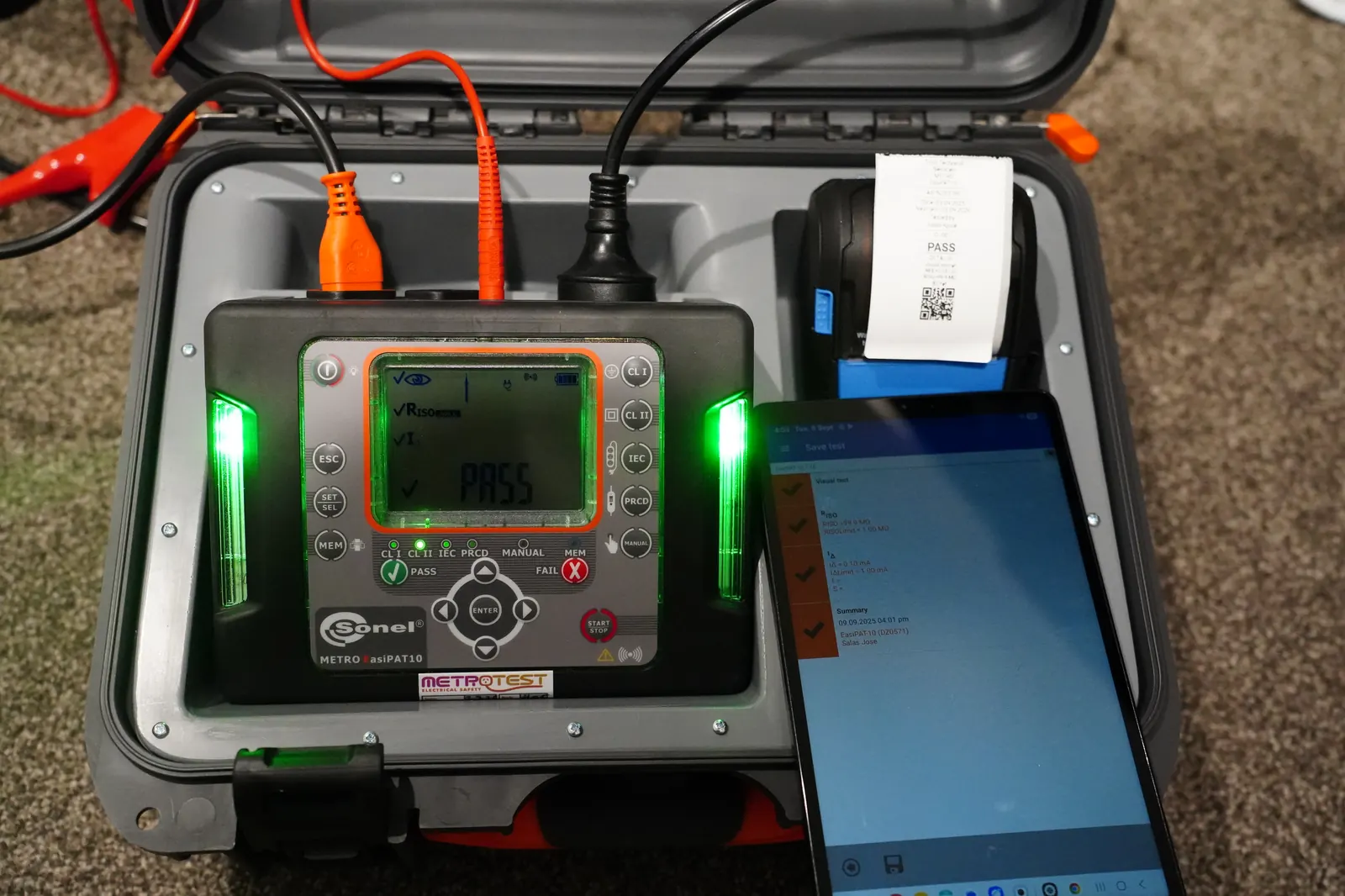
- Insulation Resistance Test: This test checks the integrity of the electrical insulation between live parts and the appliance casing, ensuring there is no path for electricity to reach the user.
- Earth Continuity Test (for Class I equipment, if applicable to the charger): This verifies a safe connection between the appliance's metal case and the earth pin in the plug, providing protection in case of a fault.
- Leakage Current Test: As a critical test for IT equipment, this powers up the charger and measures any electrical current that leaks away from the circuit while the appliance is running, which must not exceed the safe limit.
- Polarity Check (for extension leads/power boards): Verifies that the internal wiring is correct.
3. Tagging and Documentation
If the laptop and charger pass all tests, a durable Test Tag is attached. This tag is a quick reference for your staff and auditors, clearly displaying:
- The unique asset ID.
- The date of the test.
- The next required test date.
- The name/company of the competent person who performed the test.
If an appliance fails, it is immediately labelled with a distinct "DANGER - DO NOT USE" tag, withdrawn from service, and a record is made for repair by a registered electrician or disposal. A comprehensive certified report is then provided, acting as your official compliance record.
The Global Cost of Computer-Related Accidents
While PAT testing addresses physical electrical safety, the broader world of faulty computer systems - including both hardware and software errors - has resulted in massive global accidents, highlighting the need for vigilance.
- Physical Accidents from Electrical Faults: Fires and electrocutions from faulty electrical appliances are tragically common worldwide, causing extensive damage and loss of life. These are precisely the risks that proactive maintenance like PAT testing is designed to eliminate.
- Software and Technical Errors: Beyond physical faults, software bugs and system failures have caused devastating, high-cost incidents.
- The Mariner 1 Spacecraft (1962): One of the most famous software errors involved the omission of a single hyphen in a line of code, which led to the $18 million (in 1962 dollars) rocket veering off course and requiring self-destruction.
- The Therac-25 Tragedy (1980s): Programming errors in the software controlling a radiation therapy machine led to massive overdoses of radiation, severely injuring and causing the deaths of several patients.
- Major Global Outages: More recently, flaws in widely deployed security patches or cloud services have caused massive IT outages, disrupting airlines, banks, and healthcare providers globally, leading to estimated costs in the billions due to lost productivity and service failure.
These events underscore a simple truth: complexity breeds risk. For every complex system, whether it's a space rocket or a humble laptop, rigorous inspection and maintenance, both physically and digitally, is the only way to safeguard operations and lives. Read more.
Why Choose Our Professional PAT Testing Service
When fulfilling your legal duty of care, entrusting your appliance safety to professional, competent persons is the smartest choice. We are the best choice for your New Zealand workplace because:
- NZ-Specific Compliance: We operate strictly to the latest AS/NZS 3760:2022 Standard and understand the specific requirements set out by WorkSafe NZ. We ensure your testing protocols are robust and legally defensible.
- Minimised Disruption: We understand that business continuity is key. Our certified technicians use the latest, most efficient PAT testing equipment and can offer out-of-hours testing at no extra charge, ensuring your team's laptops and workflow remain unaffected.
- Specialist IT Testing: Our professionals are trained to conduct the specific low-current tests required for sensitive IT equipment, such as laptops, monitors, and chargers, ensuring safety checks are thorough without any risk of data loss or hardware damage.
- Comprehensive Digital Reporting: You receive a detailed, certified digital report of every item tested - passed or failed - which serves as a complete Asset Register and your auditable proof of compliance, making future scheduling simple.
- Automatic Reminder Service: We provide a proactive reminder service based on the required testing intervals for your specific workplace environment, ensuring you never fall out of compliance.