An AI voice receptionist is an automated voice assistant that answers calls, understands speech, and handles tasks like scheduling and data capture around the clock.
Key takeaways
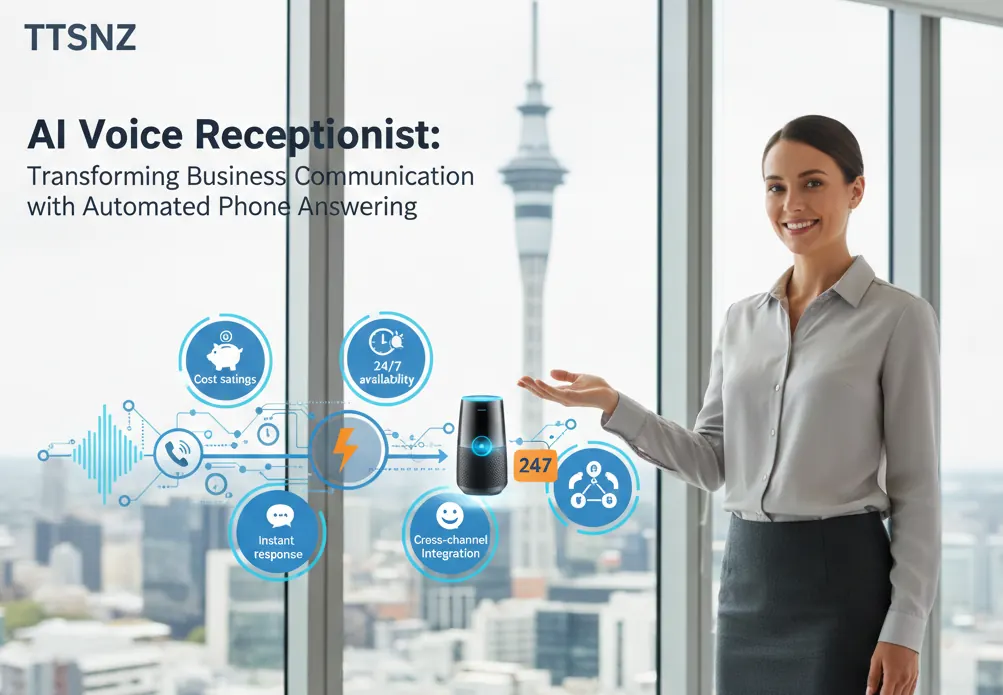
- AI voice receptionists offer substantial cost savings by automating routine tasks; the benefits of a virtual receptionist are clear across industries.
- 24/7 availability reduces missed opportunities and improves responsiveness.
- Instant responses minimise hold times, delivering faster engagements with customers.
- Enhanced customer experience through personalisation, multilingual support, and cross-channel integration (voice, chat, SMS).
- Adaptability across sectors, from healthcare to small business, enables scalable, reliable operations.
What is an AI Voice Receptionist?
An AI voice receptionist is an automated voice assistant powered by advanced technology like generative AI, large language models (LLMs), and natural language processing (NLP). These systems excel in understanding speech, responding conversationally, and performing actions such as scheduling appointments or capturing data. Unlike human receptionists limited by physical constraints, AI solutions provide scalable and uninterrupted 24/7 service. Virtual receptionist AI solutions represent a shift from traditional models by enabling around-the-clock availability and scalability that human receptionists can't match.
Benefits of Using an AI Voice Receptionist
AI voice receptionists provide numerous advantages:
- Cost-Effectiveness: Businesses save substantial costs by automating routine tasks with AI-powered reception solutions.
- 24/7 Availability: They ensure constant availability without additional staffing, which is great for global operations.
- Instant Response: AI systems typically respond within seconds, reducing hold times.
- Enhanced Customer Experience: Personalisation, multilingual support, and cross-channel integration boost satisfaction and conversion.
- Adaptability in Diverse Sectors: Healthcare providers and small businesses benefit from scalable, reliable systems that can filter spam and capture revenue opportunities.
How AI Voice Receptionists Work
These systems automate business phone automation through natural language processing (NLP) to recognise intent, generate conversational responses, and execute tasks like call routing and data logging. They integrate with existing phone systems, CRMs, and APIs to enhance personalisation and efficiency. The typical process involves greeting a caller, recognising speech and intent, routing calls, and logging data for future reference. The benefits of a virtual receptionist provide a good blueprint for implementation.
Considerations for Implementing an AI Voice Receptionist
When considering AI phone receptionist systems, businesses should be aware of:
- Initial Setup Challenges: Integration and ensuring natural voice quality can be complex.
- Handling Complex Queries: May struggle with intricate consultative scenarios; human support could be needed.
- Costs and ROI: While upfront costs vary, savings can be quick with high-volume tasks.
- Privacy and Data Security: Address security and compliance, often via human-in-the-loop approaches.
Comparing AI Voice Receptionists and Human Receptionists
Comparison chart:
| Feature | AI Voice Receptionist | Human Receptionist |
|---|---|---|
| Availability | 24/7, scalable | Limited shifts |
| Cost | Lower operational costs | Salaries and benefits |
| Speed | Instant or 0-1 rings | Varies with queue |
| Scalability | Handles peak traffic | Requires hires |
| Features | Multilingual, personalised | Subject to fatigue |
Augmenting AI with human skills can benefit businesses with high complexity or empathy demand tasks, making both options viable based on specific needs.
Case Studies / Success Stories
Contractor businesses report significant reductions in operational costs and improved service quality compared to voicemails. Healthcare practices using AI-enabled scheduling platforms see growth through efficient 24/7 bookings and smoother handoffs to humans. Real-world case studies underscore the transformative impact across industries.
Future of AI in Receptionist Roles
Looking ahead, advancements include voice emotion detection, predictive routing, and deeper CRM integration. By 2030, many roles will be augmented by AI, with emphasis on analytics and system optimisation. AI-receptionist statistics shed light on trends, and human backup integrations remain part of the picture.
Conclusion
Incorporating an AI voice receptionist into business operations offers unmatched efficiency, cost savings, and round-the-clock service. As businesses evaluate communication needs, AI-enabled business phone automation promises transformative benefits. Explore options, assess requirements, and consider a demo to leverage this technology today. The benefits of a virtual receptionist provide a helpful starting point.
Frequently Asked Questions
What workplaces benefit the most from an AI voice receptionist?
Organisations with high call volumes, 24/7 service needs, and multilingual support often see the strongest ROI from AI voice receptionists.
Can AI voice receptionists handle complex conversations?
They excel at routine tasks and basic inquiries; more complex consultative or nuanced sales scenarios may require human handoffs or hybrid workflows.
How secure is data handled by AI receptionists?
Data security is a priority; implement privacy controls, encryption, and, when needed, human oversight to ensure compliance.
What is the typical implementation timeline?
Setup times vary, but many teams deploy in weeks, with iterative improvements post-launch.