Choosing between custom website development vs templates impacts branding, UX, scalability, and costs, so it pays to understand the trade-offs before you build.
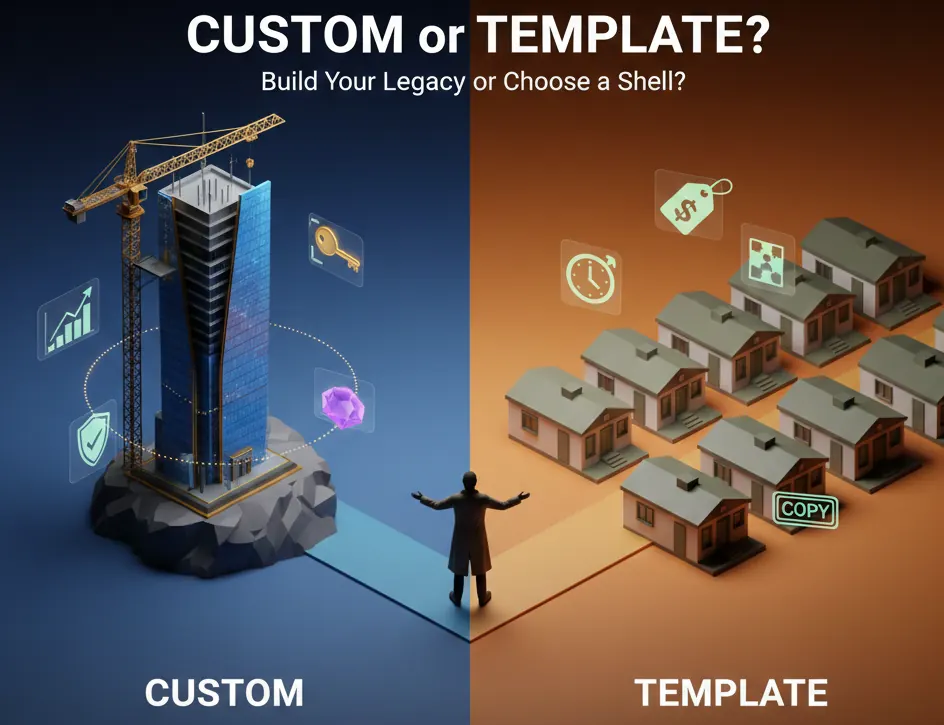
Key takeaways
- Choosing between custom website development vs templates impacts branding, UX, scalability, and costs.
- Custom websites offer unique design, full control, superior performance, and tailored SEO, at higher upfront cost and longer timelines.
- Template-based sites provide quick setup, affordability, and ease for non-technical users but may limit flexibility and uniqueness.
- Businesses requiring complex functions, growth potential, and strong branding often benefit from custom development.
- Startups or personal projects with tight budgets and simple needs may find templates sufficient.
Overview of Website Development Options: Custom Website Development vs Templates
At the core of the custom website development vs templates debate are two distinct paths for creating your online presence.
What Is Custom Website Development?
Custom website development involves creating a unique website built from scratch, precisely tailored to your business's specific needs. This approach gives you full control over design, functionality, performance, and integrations. For example, you can incorporate complex CRM systems, bespoke e-commerce features, or interactive portals without relying heavily on third-party plugins.
Key characteristics of custom development include:
- Truly unique branding elements such as layouts, animations, and typography.
- Full ownership of code, enabling cleaner performance and advanced security.
- Scalability to expand features or handle more traffic without major overhauls.
Startups scaling into growing enterprises often find custom solutions crucial for staying competitive. For advice on how to clearly communicate your specific business needs to developers, see how to communicate your business needs to a web developer.
What Are Template-Based Websites?
Templates are pre-designed layouts or themes offered by platforms such as WordPress, Wix, or Squarespace. These come with drag-and-drop editors for easy customization, generally suitable for non-technical users who want to launch a site quickly.
Common traits of templates include:
- Fast setup, often within days or weeks.
- Lower costs upfront.
- A large selection of industry-specific designs ready to use.
- Limited customizability confined mostly to colors, fonts, and images.
Templates fit businesses or individuals aiming for quick informational sites or simple portfolios. For instance, a local bakery launching a basic website may find a template sufficient, while larger companies requiring tailored e-commerce functionalities may face constraints.
Comparison in Key Areas
| Aspect | Custom Website Development | Template-Based Websites |
|---|---|---|
| Control | Full control over design, code, and integrations | Limited to predefined theme settings |
| Speed | Longer development timelines (weeks to months) | Rapid deployment (days to weeks) |
| Scalability | Easily expanded with complex features | Limited scalability; growth can be constrained |
| Security | Enhanced with custom code and hardening | Vulnerabilities in popular templates/plugins |
| SEO | SEO-friendly coding and architecture | Often bloated code affecting rankings |
| Technical Skills Needed | Requires expert developers for build and upkeep | Minimal skills needed; user-friendly |
Overall, startups and personal projects may favor templates for affordability and speed, whereas growing enterprises benefit from custom development's flexibility and robustness. For more on the benefits of having a website for business growth, check benefits of having a website for business.
For further reading on these distinctions, visit Company119's insights on Custom Website Design vs Template and BlueSoftDesign's analysis.
Pros and Cons of Custom Website Development
Understanding the pros and cons of custom web development helps clarify when this approach is right and what challenges to expect.
Pros of Custom Website Development
- Tailored Solutions for Branding — A custom-built website lets you create unique layouts, colors, and typography that perfectly align with your brand identity. Unlike templates, you're not boxed into preset designs shared by many others. This strengthens your online presence and connection with your audience. More on tailored branding
- Scalability and Flexibility — Custom development supports future growth by allowing you to add new features, such as interactive portals, animations, or integrations with third-party systems like payment gateways or CRM tools. This scalability means you can adapt your website as your business evolves without rebuilding from scratch. Insights on scalability
- Enhanced Performance and Security — Custom codebases are typically cleaner and optimized, leading to faster load times and better user experience. Moreover, tailored security measures protect against vulnerabilities common in widely-used templates and plugins, reducing hacking risks. Details on performance and security
- Superior SEO and User Experience (UX) — Custom sites often employ efficient, minimal code that helps with SEO rankings and page speed. UX is directly designed around your audience's needs and conversion goals, resulting in an intuitive, engaging site. SEO and UX advantages
Cons of Custom Website Development
- Higher Upfront Costs and Longer Timelines — Building a website from scratch requires skilled developers and designers, making custom projects more expensive and time-consuming compared to templates. It may take weeks or months before launch. Cost and timeline considerations
- Ongoing Maintenance Requires Expertise — Custom websites need continuous updates, security patches, and feature enhancements. This means maintaining an in-house technical team or outsourcing, which adds to long-term expenses. Maintenance challenges
For a full breakdown of these points, check out Company119's detailed comparison.
Pros and Cons of Template-Based Websites
Template-based websites have their place, especially for businesses with limited resources or urgent timelines.
Pros of Template-Based Websites
- Lower Upfront Costs and Faster Setup — Often ranging between $50 and $200 plus minimal hosting fees, templates enable fast deployment, sometimes within days. This affordability suits startups or small projects with tight budgets. Cost and speed benefits
- User-Friendly for Non-Technical Users — Their drag-and-drop editors and built-in responsiveness make templates accessible to individuals without coding skills. Managing content, images, and basic customization requires little training. Ease of use explained
- Wide Range of Designs — Templates cover many industries and styles, allowing you to quickly select a professional-looking design with minimal effort. This variety helps businesses quickly establish an online presence. Variety of options
Cons of Template-Based Websites
- Limited Flexibility and Scalability — Templates can struggle with implementing complex features or adapting to significant growth. Adding functionality often relies on multiple plugins, which may conflict and degrade site performance over time. Concerns about scalability
- Generic Appearance Risks — Because many sites use the same or very similar templates, your site might look like competitors, reducing the distinctiveness of your brand online. Branding impact
- Performance and Security Issues — Templates often bring code bloat from excess features and may depend on third-party plugins vulnerable to hacking. This can result in slower page load speeds, harming SEO and user engagement. Security and performance pitfalls
If you want to explore these pros and cons further, see BlueSoftDesign's comparison and Jessica Miller's blog on templates vs custom websites.
Why Template-Based Websites May Not Be Enough
While tempting for their ease, template-based websites may not be enough for many businesses, particularly those with growing or unique needs.
Limitations in Functionality
Businesses that require unique functions — such as advanced e-commerce, booking systems, or interactive tools — often find templates restrictive. Structural limits prevent seamless integration or require complex workarounds, which slows development and frustrates users.
For example, a medical scheduling system or a tailored online learning platform typically needs custom-built elements to perform reliably. For guidance on managing your web development project to ensure it meets such complex goals, check managing your web development project.
SEO Challenges
Templates sometimes contain bloated, inefficient code that slows loading times. Since page speed is a Google ranking factor, this can negatively impact your site's organic visibility. Custom sites, in contrast, have SEO-optimized foundations that boost search rankings.
Lack of Branding Uniqueness
Using a popular template means many competitors might share that same look and feel. This dilutes your branding, making it harder to stand out in crowded markets.
Scalability and Security Concerns
Templates may become outdated quickly. As your business grows, you might want to add features that don't mesh with your initial template, causing slower mobile experiences and widening security vulnerabilities. Moreover, popular plugins may attract hackers targeting widely-used software.
For more detail on why templates could fall short, read BlueSoftDesign's take and Jessica Miller's blog.
Factors to Consider When Choosing Between Custom Development and Templates
Deciding between custom website development vs templates depends on multiple factors. Here's a clear framework to help you evaluate your best option.
Budget
- Templates: Ideal for tight budgets or urgent timelines. You can launch a site for under $200 quickly without technical staff.
- Custom Development: Requires a higher upfront investment, often in the thousands, plus ongoing maintenance costs. However, it delivers long-term value through enhanced performance and growth capability.
Business Goals and Growth Potential
- Templates: Best suited for startups, informational sites, or static businesses with minimal needs.
- Custom Development: Needed if you expect substantial growth, require complex features, or want a site that evolves with market demands.
Target Audience and User Experience (UX)
- Templates: Provide basic, user-friendly interfaces adequate for casual or low-traffic audiences.
- Custom Development: Allows creation of personalized, immersive experiences tailored to deeply engage your audience, enhancing conversions and loyalty.
Technical Skills Availability
- Templates: Non-technical in-house teams can maintain and update these sites easily.
- Custom Development: Usually requires external developers or highly skilled internal staff to manage updates, security, and feature rollouts.
Comparison Table
| Factor | Custom Development | Templates |
|---|---|---|
| Cost | High upfront, ongoing maintenance | Low upfront ($50–$200), minimal maintenance |
| Timeline | Longer (weeks to months) | Fast (days to weeks) |
| Scalability | High; can add complex features and handle growth | Limited; tricky to expand beyond basic functions |
| Uniqueness | Fully branded; custom design and code | Risk of generic look shared by many |
| Performance/SEO | Optimized for speed and rankings | Often bloated; reliant on plugins |
| Technical Skills | Requires experts for development and maintenance | User-friendly for non-technical users |
For a detailed guide on these factors, visit Company119's Custom Website Design vs Template insights and BeKnown NYC's review.
Conclusion: Which Approach Should You Choose?
Choosing between custom website development vs templates hinges on balancing budget, business goals, technical resources, and user experience expectations.
- Custom Development is best if you aim for tailored scalability, robust security protections, strong, unique branding, and superior SEO and UX to support long-term success.
- Templates shine when you need a quick, affordable launch, basic site needs without complex features, and easy management by non-technical staff.
Templates may suffice for simple startups or personal projects but can limit growth and distinctiveness as your business matures.
Ultimately, assess your current situation and projected needs carefully. This will help you select the right path and budget for your website's future. For further guidance, see detailed comparisons at CleverLight and Jessica Miller's blog.
To better understand how a website can help your business grow and increase customer trust, explore benefits of having a website for business.
Frequently Asked Questions
- What is the main difference between custom website development and templates?
Custom development creates a fully unique site built from scratch tailored to your exact business needs, while templates use pre-designed themes offering faster, less expensive setup but with limited customization. - Are templates suitable for growing businesses?
Templates may be suitable for startups or small businesses that require basic functionality. However, growing businesses often find templates restrictive in scalability and personalization. - Can I switch from a template to a custom website later?
Yes, but migrating can be complex and costly, especially for content and SEO preservation. Planning your long-term needs early can save time and expense. - How do costs compare between custom development and templates?
Templates are typically much cheaper upfront ($50–$200 plus hosting), while custom sites involve higher initial investment (thousands of dollars) plus ongoing maintenance. - Where can I learn more about communicating my business needs to web developers?
For guidance, visit this resource on how to communicate your business needs to a web developer.